For reading interventionists, dyslexia specialists, and PreK–grade 3 teachers. Built by an educator with doctoral research in STEM and literacy, for the small-group table and the intervention block.
The pedagogy, first
Scope & sequence
Reading Forge follows one explicit, cumulative sequence — ten regions, about 120 tracked skills, roughly Pre-K through grade 4 — each building on the last, with spaced review threaded throughout. Here are the first five; the map runs all the way to syllable division and morphology.
First letter sounds, formation & phonological awareness
s · a · t · p · i · n …
PreK–KShort vowels + CVC blending and segmenting
cat · sit · mop · bed
KindergartenConsonant digraphs — two letters, one sound
sh · ch · th · wh · ck · ng
K–Grade 1Consonant blends + FLOSS and -ck spelling rules
stop · blend · trip · pass
Grade 1Magic e (VCe) — the silent e wakes the vowel
cake · bike · home · cute
Grade 1…and five more: vowel teams, r-controlled vowels, diphthongs, syllable types & division, and morphology. See the full ten-region map →
Teacher tools
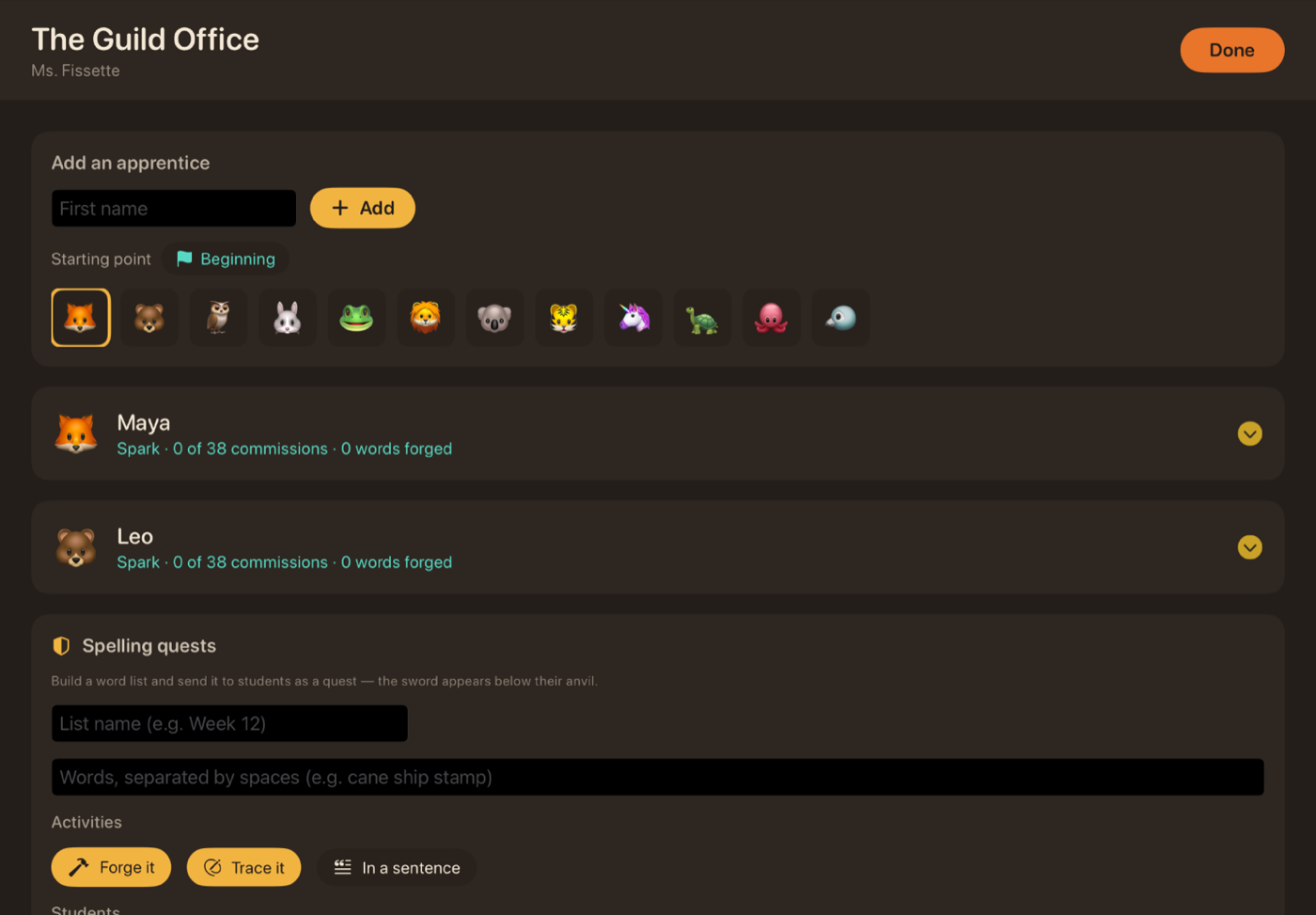
Start each student where they actually are in the sequence — essential when your caseload spans three grade levels.
Not percent scores — actionable flags like "confuses b with d," plus per-skill mastery levels and time-on-task charts.
Printable progress reports for parent conferences, RTI documentation, and IEP files.
Assign targeted practice on a specific skill; the student sees a quest, you get a completion notice.
Replace the app's audio with your own voice, organized by the 44 phonemes, short and long vowels kept separate. Children decode speech more accurately from a familiar voice — the research-backed familiar-talker advantage, strongest in a noisy classroom.
Try it yourself · the Sound Forge
This is the heart of the game — the Sound Forge. Tap a tile and it plays the sound that letter makes (not its name); build the word from its sounds, then hammer them together into a word.
Forge the word… "cat" 🐈
The whole learner, on one page
One tap generates a printable PDF: mastery by sound, what to watch for, time on each activity, and every session. Here's a sample — the kind of documentation that fits straight into a conference or an IEP file.
Privacy & procurement
Reading Forge today has no student accounts, no logins, and no data collection of any kind. Profiles live on the device behind a teacher password, and the app runs fully offline — there is simply no student data to breach, sell, or subpoena. COPPA and FERPA conversations get very short.
One teacher, every iPad: push activities to the whole class, watch live progress tile by tile, and freeze every screen with one tap — the same structured-literacy game, plus a live teacher console, running entirely on your school's local WiFi with no student accounts and no student data collected. School licenses from $5/student/year, single classroom $149/year, and free scholarship licenses for schools that can't fund one.
Free for teachers & families
Grab a one-page reference — the 44 sounds with keywords, plus the full ten-region scope & sequence. Print it, pin it by the table, share it with a colleague.
Reading Forge is on the App Store — free to download, first regions free forever. Interventionists and specialists are exactly who we built it for. Working with whole classes? Reading Forge Classroom is now on the App Store — request a quote or a live demo.
Download on the App Store
 Reading Forge