 A Forge Learning Technologies product
Reading Forge turns the science of reading into a warm fantasy craft game. Your child is an apprentice smith, and every phonics skill they master lets them shape letters, sounds, and words into artifacts, tools, and stories. It's explicit, structured-literacy instruction in the Orton-Gillingham tradition — built for beginning readers, students with dyslexia, tutors, and homeschoolers.
Every mechanic is the literacy task
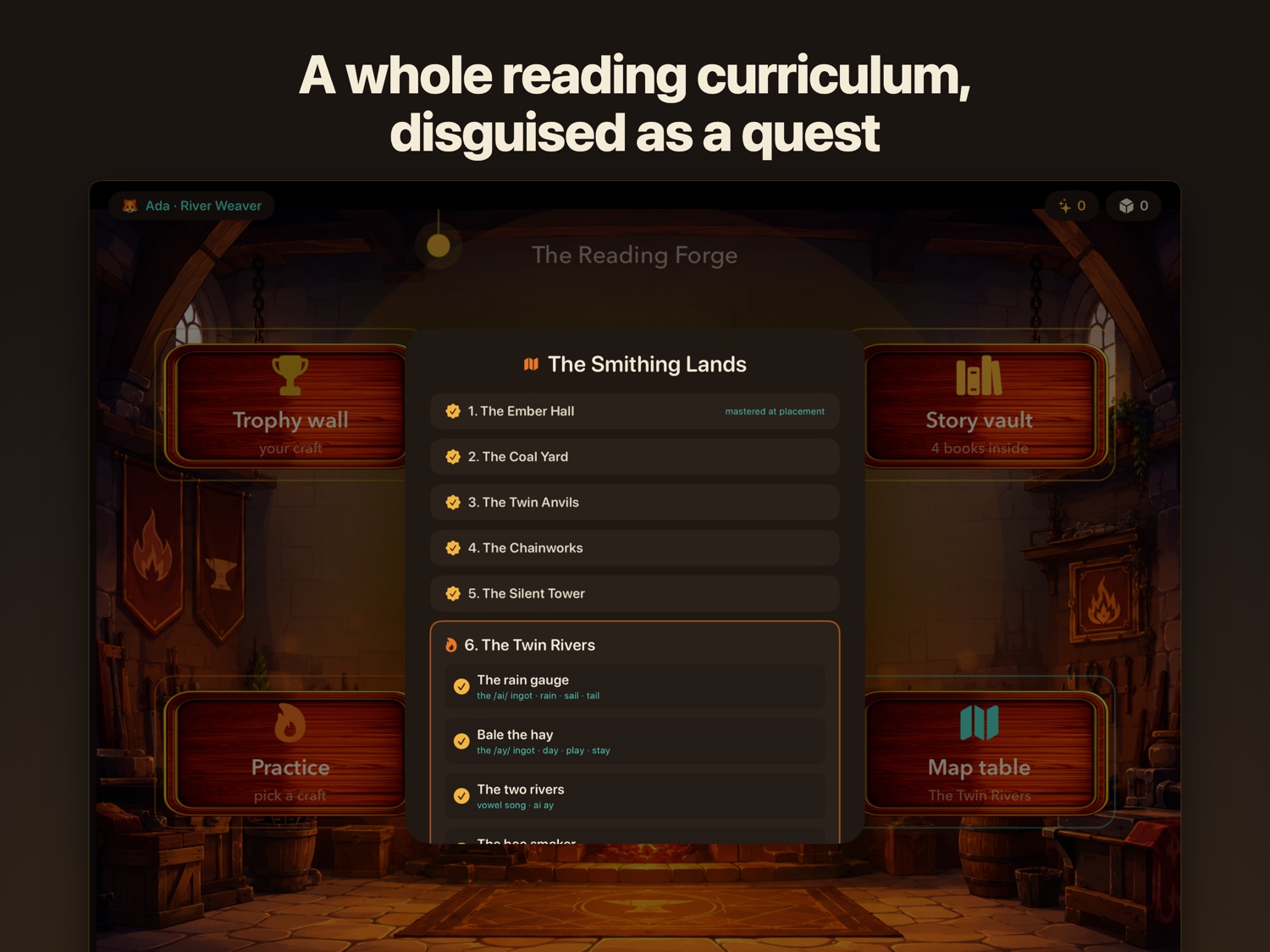
In most "learning games," the fun and the learning are separate. In Reading Forge, the smithing fantasy and the reading science are the same motion. Inside: the full 10-region curriculum, every activity, a Story Vault of decodable readers, multiple child profiles, grown-up progress reports, and a recording booth to use a familiar voice.
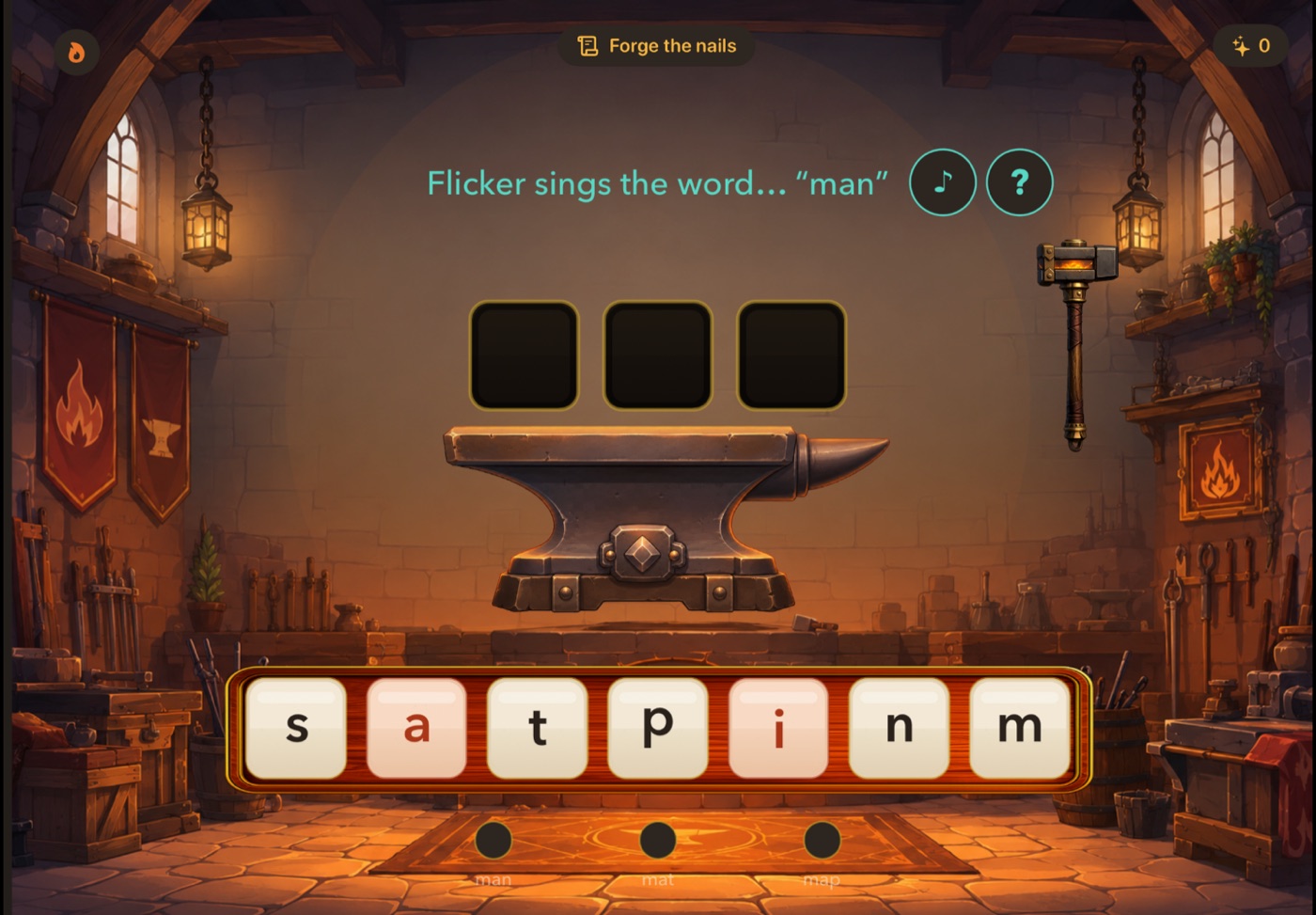
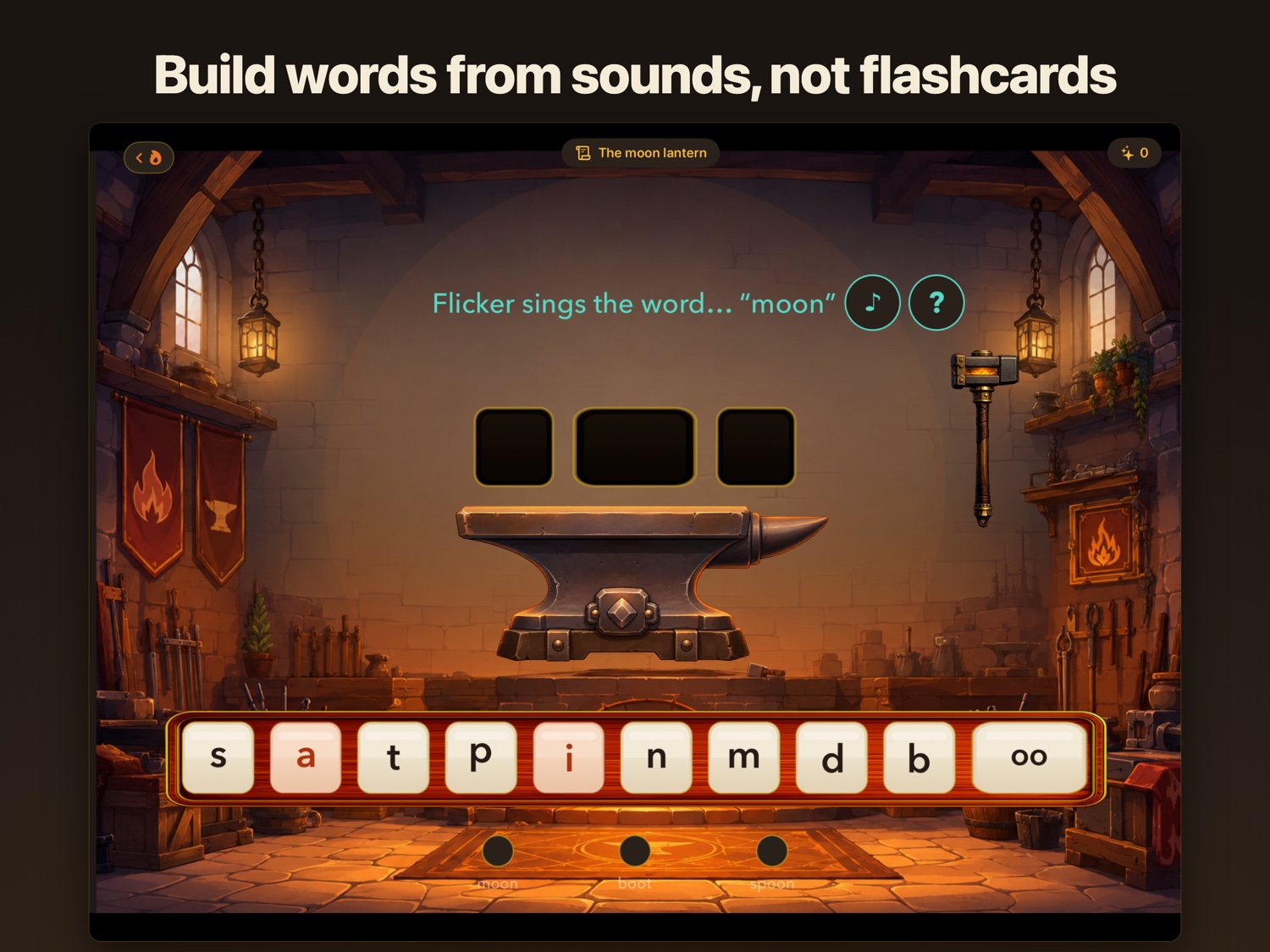
Drag grapheme tiles into place and hammer them to blend sounds into words — the core act of decoding, made physical.
When s and h meet, they fuse into one glowing tile — two letters, one sound. Digraphs like sh, ch, and th make sense on sight.
Magic e doesn't just sit there — it casts a spell that wakes the vowel and changes its sound. Kids see why "can" becomes "cane."
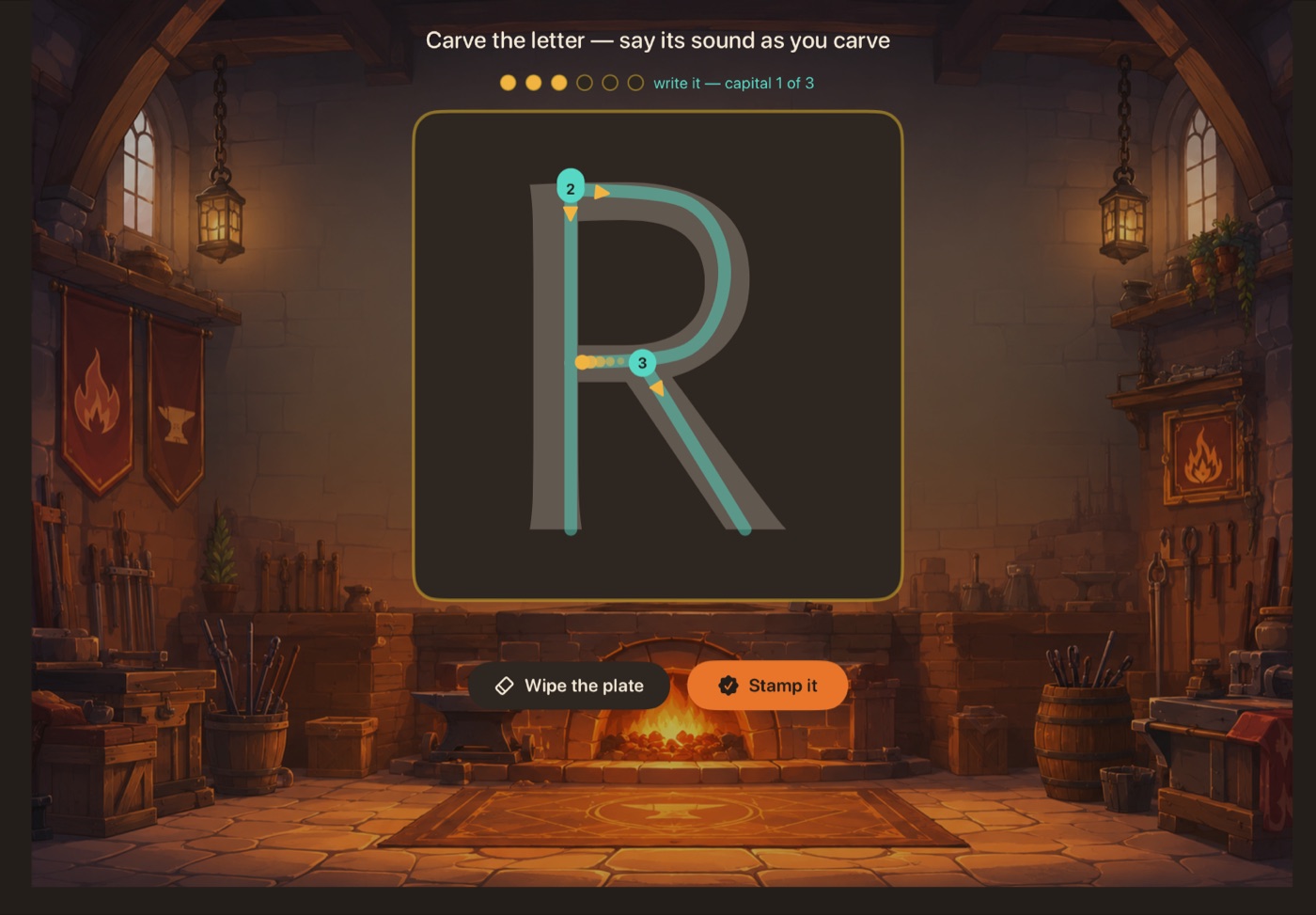
Letter formation follows real handwriting strokes on the engraving plate, with say-it-as-you-write multisensory practice.
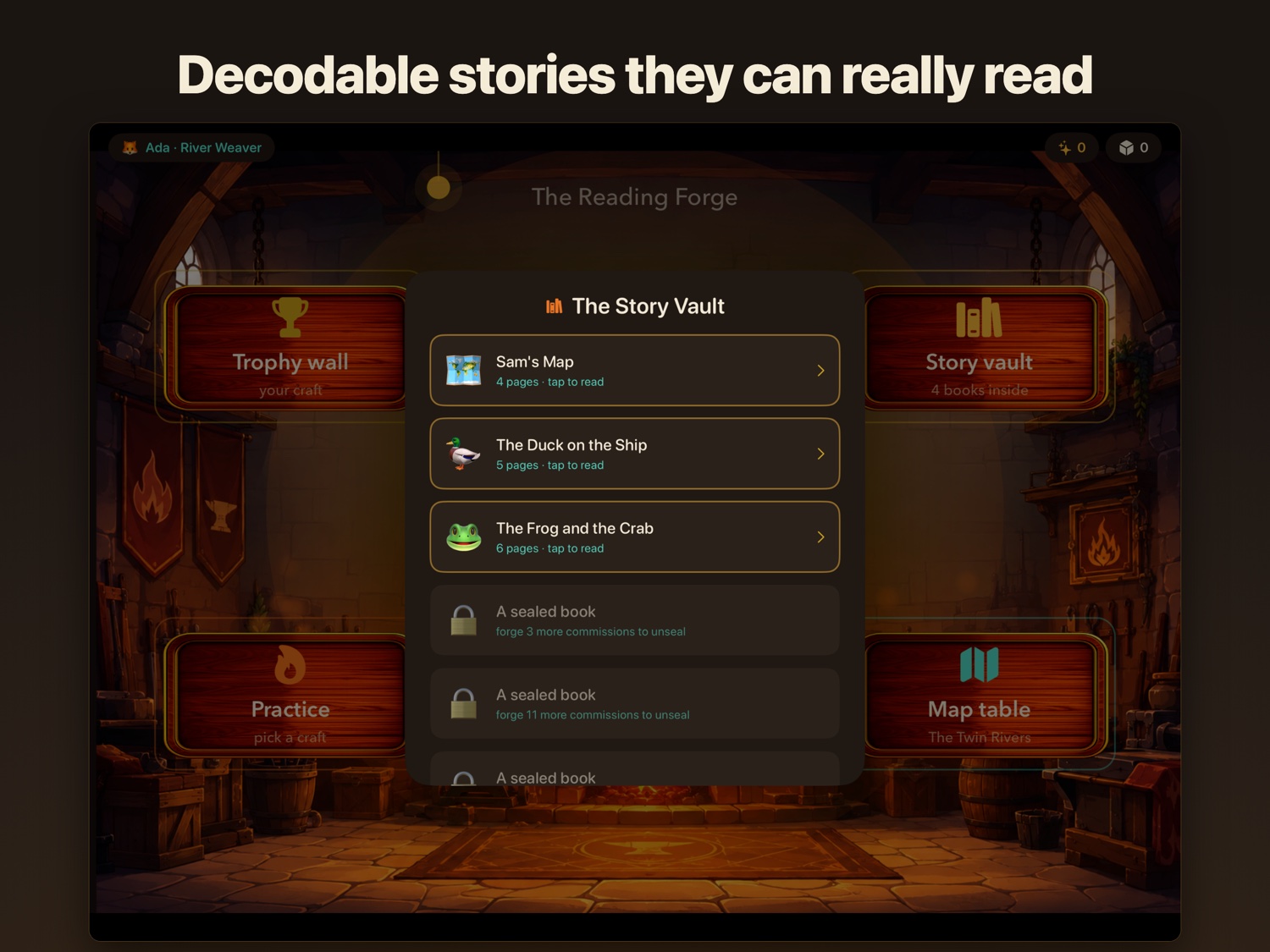
Word-by-word guided reading of decodable sentences and unlockable storybooks — everything a child reads, they can decode.
Try it yourself · the Sound Forge
This is the heart of the game — the Sound Forge. Tap a tile and it plays the sound that letter makes (not its name); build the word from its sounds, then hammer them together into a word.
Forge the word… "cat" 🐈
How it works
Every mission follows the shape of a classic explicit, systematic lesson — but the child experiences it as stations in a smith's workshop. Each phase is short, and a whole mission takes 8–12 minutes.
Feed glowing phonogram coals into the hearth — see the grapheme, say the sound. Spaced review of everything taught so far.
Flicker sings a sound; the apprentice picks the right raw ore. Hear the phoneme, choose the grapheme.
Master Ember unveils a new phonogram — the mouth shape, the sound, and a keyword image forged from the letter's own shape.
Trace the new grapheme on the engraving plate with Apple Pencil or a finger, following real handwriting formation, saying the sound as you write.
The heart of every mission: drag tiles onto the anvil and hammer them to blend sounds into words.
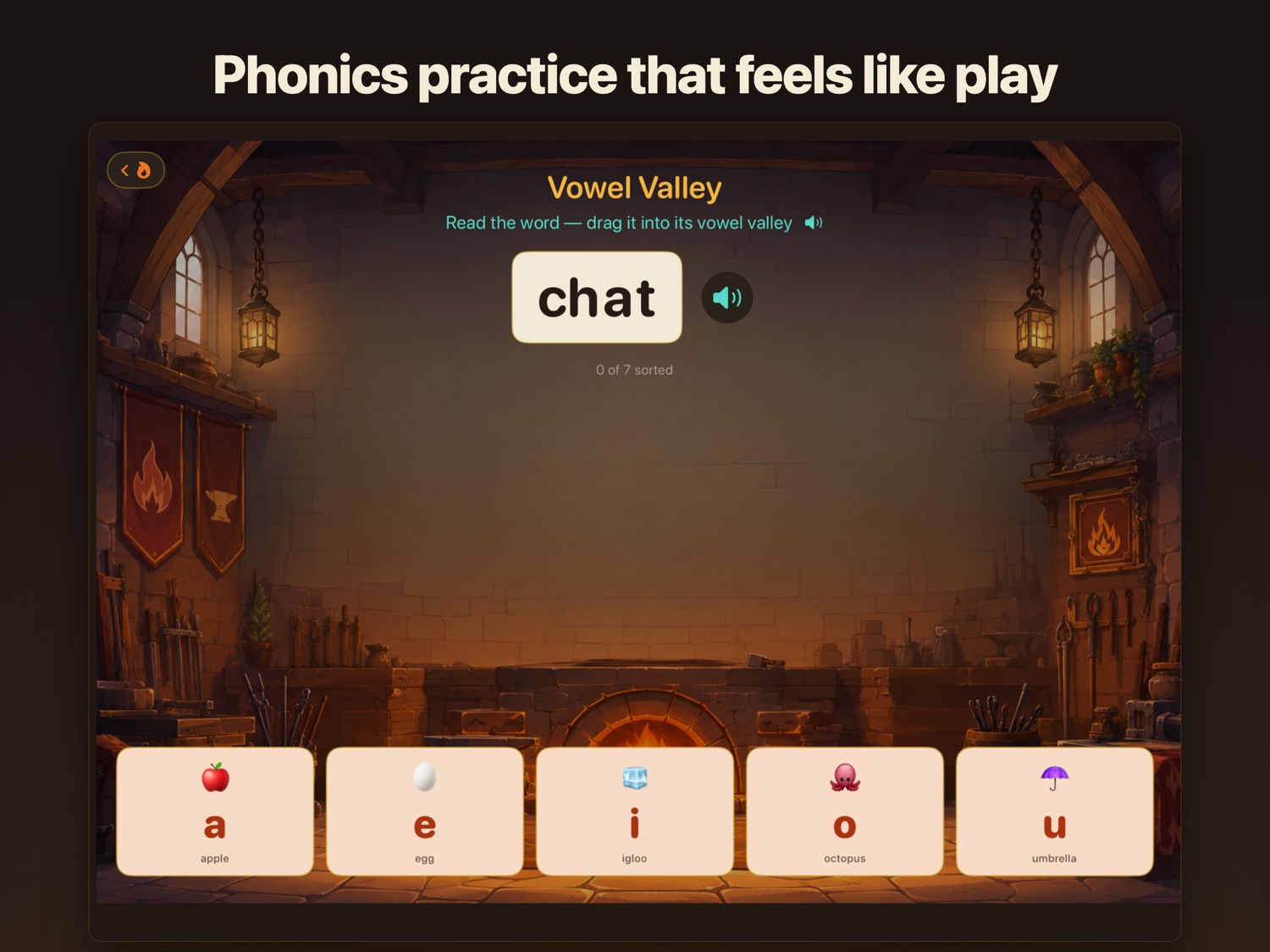
Word chains, syllable splitting, and pattern sorting — flexible manipulation that turns a new skill into a durable one.
Read the customer's order aloud or write it from dictation — decodable sentences that use only what's been taught.
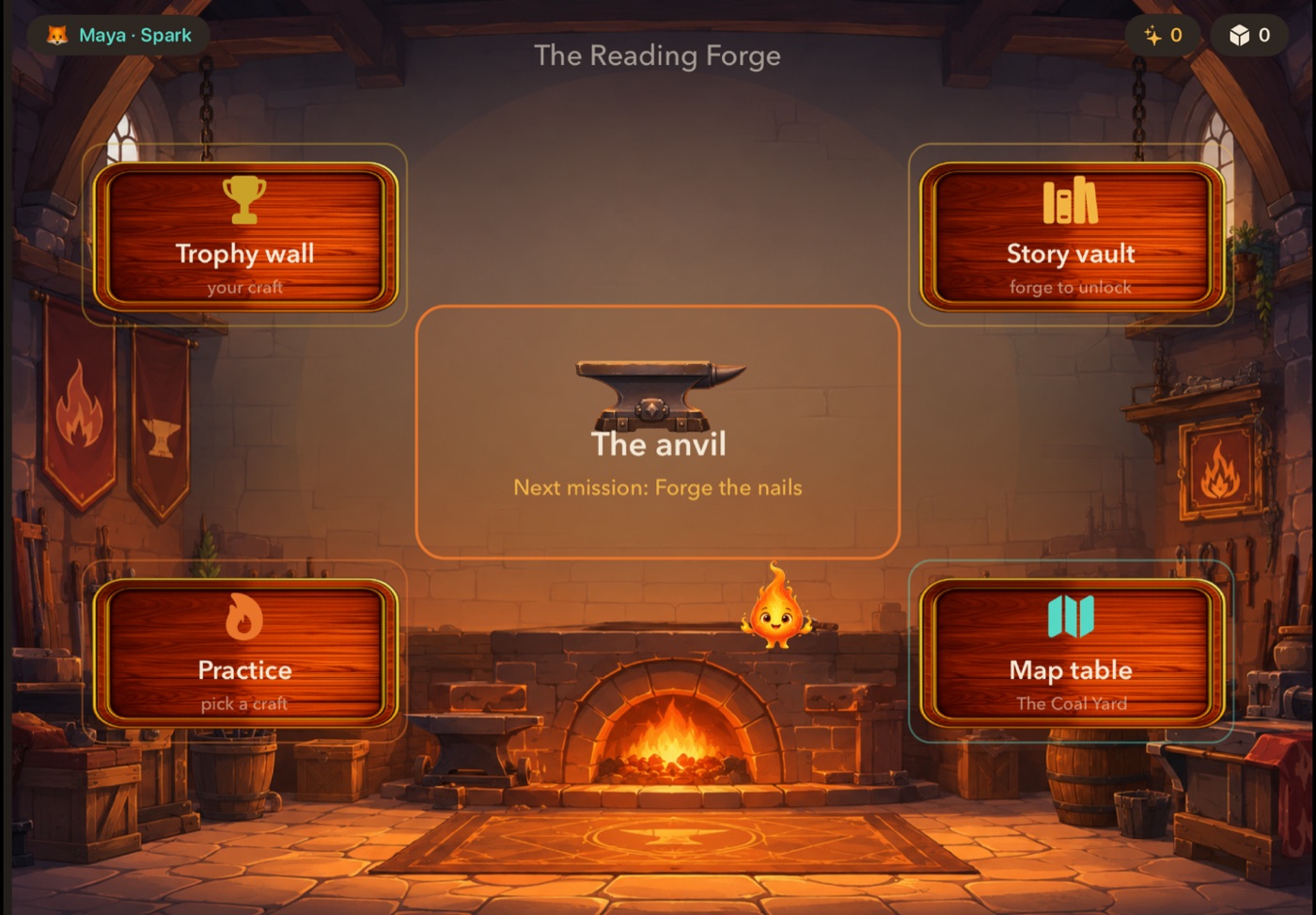
Inside the forge
The pedagogy
Reading Forge was developed by an educator whose doctoral research focused on STEM and literacy, and it's built on the same principles as classic multisensory structured-literacy programs.
An automated decodability linter checks every word, sentence, and book in the curriculum against the scope and sequence. If a single word uses a pattern that hasn't been taught yet at that point, the app literally fails to build. That guarantee isn't a policy — it's enforced by the same machinery that catches programming errors.
Your voice, not a robot's
Most reading apps ship one canned narrator — or a robotic text-to-speech voice. Reading Forge has a recording booth: a teacher or parent records all 44 speech sounds and the words in their own voice, with built-in coaching (“/m/ as mmm, never ‘em’”). From then on, the game speaks in that voice everywhere.
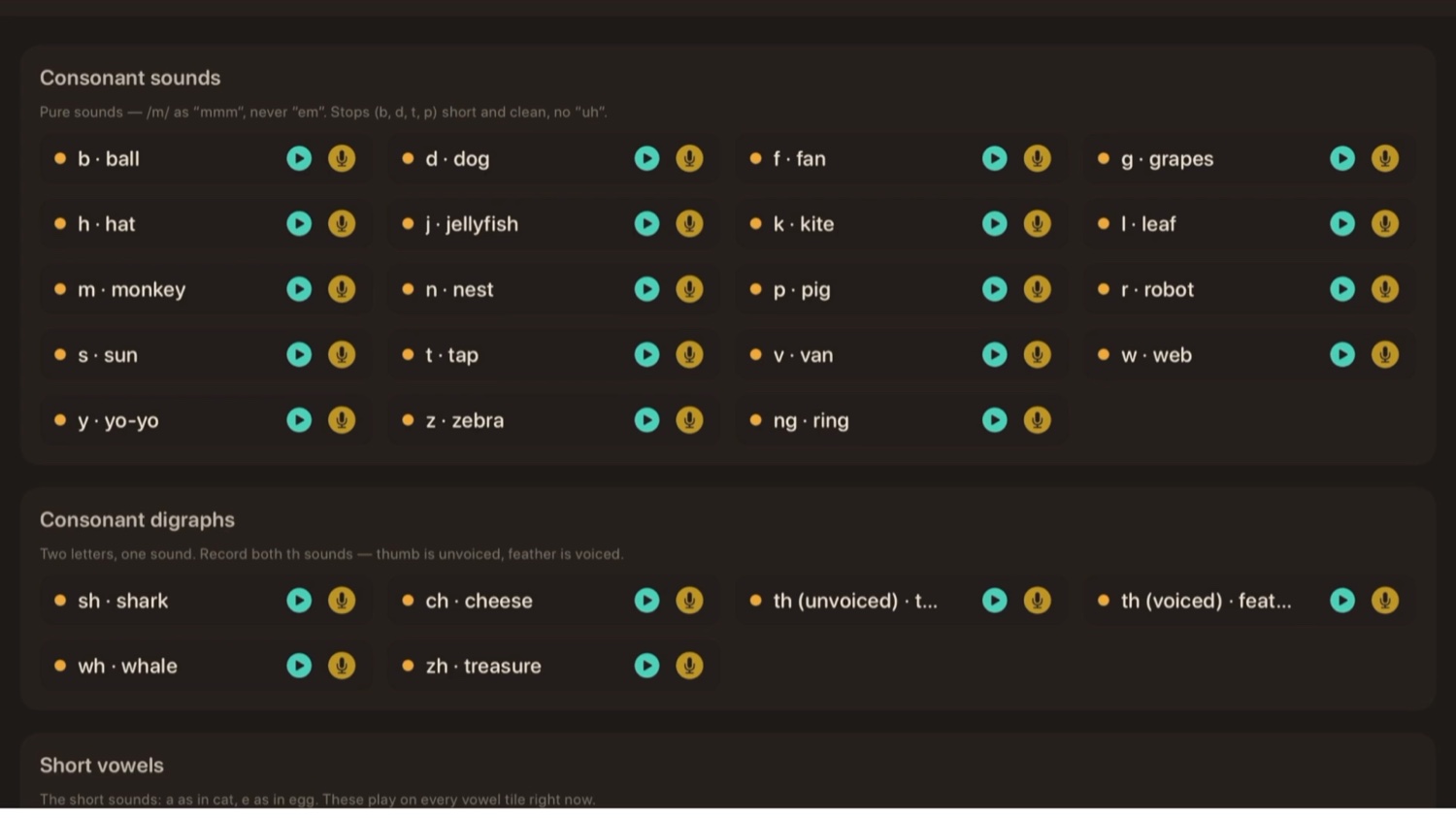
The booth is designed around a well-documented finding: children perceive and decode speech more accurately when it comes from a familiar voice, and expressive human speech supports attention and word learning more than flat, synthetic voices. These are speech-perception and language-learning studies — we point to the mechanism, not a promise of specific results.
How it's different
In most kids' apps, the fun is a bribe bolted onto drill — points and mascots that have nothing to do with the skill. Reading Forge is the opposite: the game is the structured-literacy lesson.
For educators
Whether you're a classroom teacher, an interventionist, or a homeschool parent, the teacher tools are designed to answer the questions you actually ask.
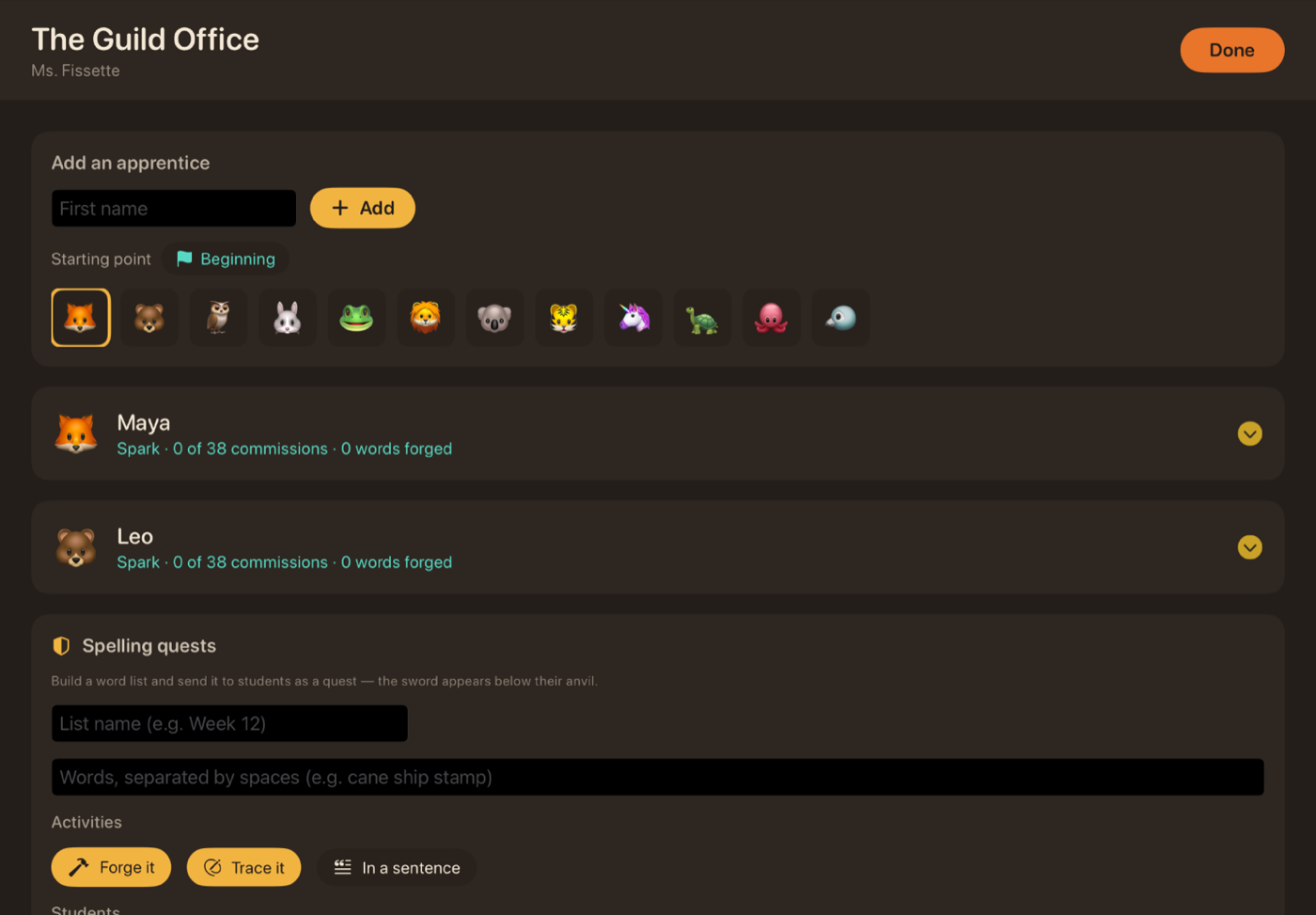
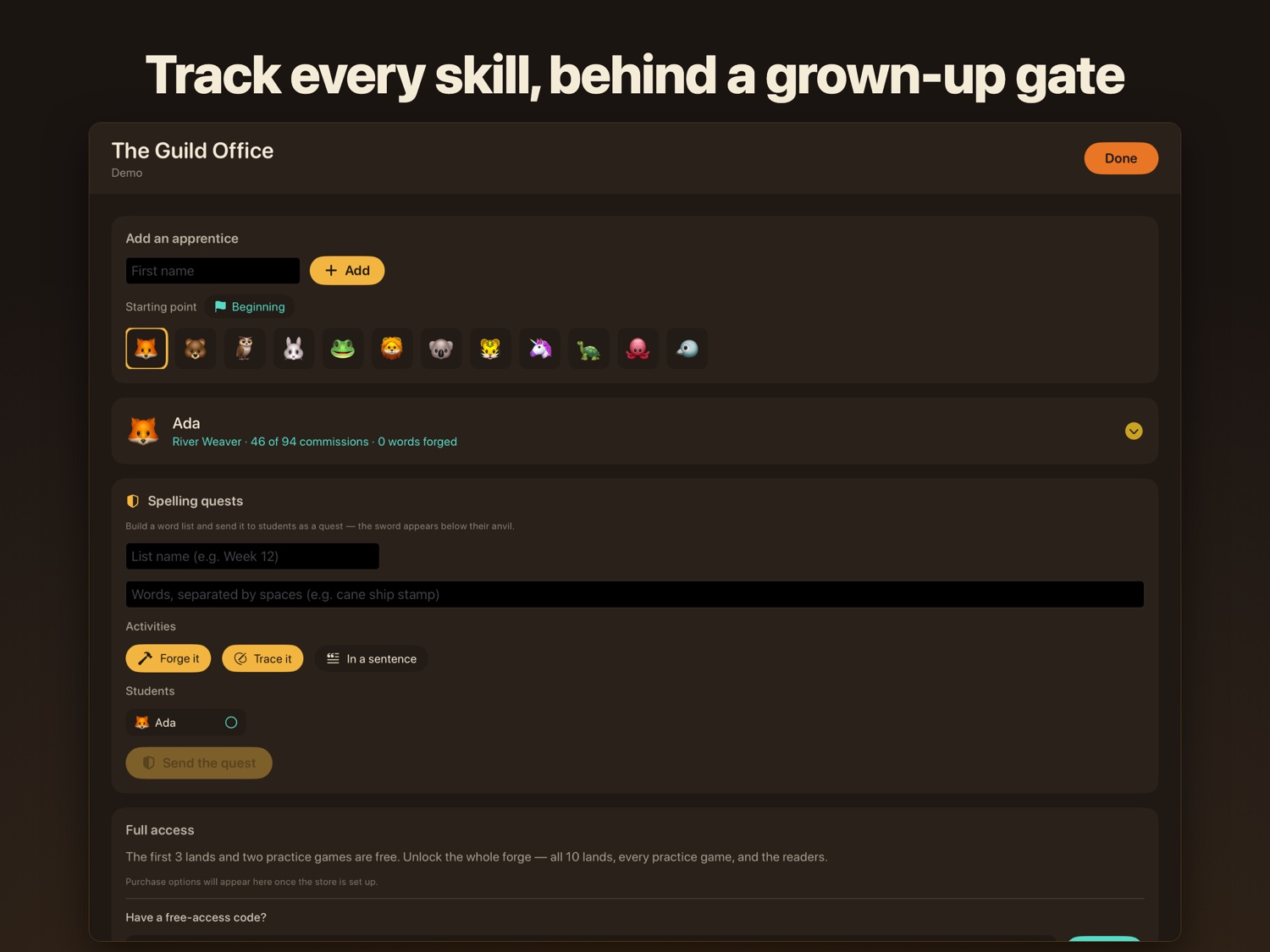
A password-gated teacher space on the same iPad: add apprentices in seconds (no child accounts, ever), see each student's rank, commissions, and words forged at a glance, and open any profile for mastery detail, confusion flags, and printable reports.
Start each student at the right point in the sequence instead of forcing everyone through mission one.
Per-skill mastery with confusion flags — it will tell you a student confuses b with d, not just a percent score.
Time-on-task metrics, charts, and printable progress reports ready for parent conferences and IEP documentation.
Assign targeted practice to any student and get a completion notice when it's done.
Replace all audio with your own voice, organized by the 44 phonemes — your students hear you, pronounced the way you teach it. Why a familiar voice matters →
Student profiles live on the device. No sign-ups, no data collection, COPPA-friendly, fully offline.
See the whole learner
One tap turns a child’s practice into a printable PDF — mastery by sound, what to watch for, time on each activity, and every session. Here’s a sample.
Rewards without manipulation
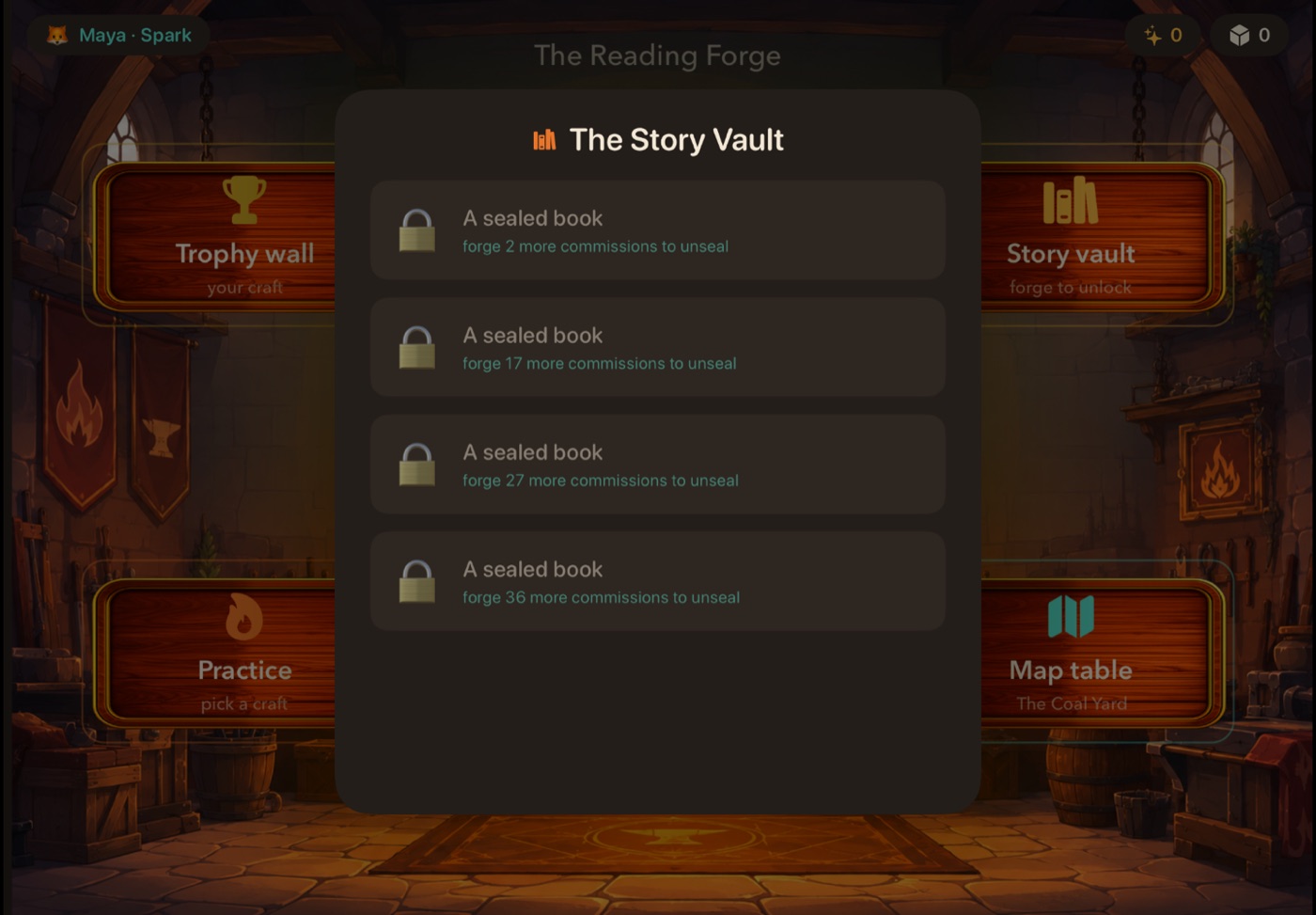
Earn sparks, iron, and guild stars. Climb the rank ladder from Spark to Reading Master. Unlock decodable storybooks in the Story Vault. And that's it — motivation comes from craft and story, not from pressure.
Questions
Foundational readers from PreK through 3rd grade — in the classroom, homeschool, or at home — plus older students who are still building those foundational skills. The apprentice-smith world is cozy for the youngest and dignified enough that an older struggling reader never feels like it's a "baby app."
It's inspired by the Orton-Gillingham approach and built on the same structured-literacy principles: explicit, systematic, cumulative, and multisensory instruction with decodable text. We don't brand it as OG — we'd rather show you the scope and sequence and let you judge the pedagogy directly.
Completely. Reading Forge makes no network requests during play, which also means no data about your child ever leaves the device.
iPad and iPhone. iPad is the best experience — especially with an Apple Pencil for letter tracing, though a finger works fine too.
No. Children never create accounts. A teacher or parent creates local profiles on the device, protected by an adult password. Nothing is collected, tracked, or uploaded.
Yes — Reading Forge Classroom puts a whole class of iPads under the teacher's control: push activities, watch live progress, lock every screen. It runs on your school's local WiFi with no student accounts. Now on the App Store — request a quote or a live demo; school licenses from $5/student/year.
Free to download, and the first regions (letters, short vowels, and blends) are free forever. The full curriculum is $4.99/month or $39.99/year. If cost is a barrier, families and schools can request free access through our nonprofit partner Ace Schools. See the pricing page.
See it in action
From first letter sounds to morphology — this is Reading Forge on iPad.
Why I built this
My doctoral research explored the intersection of STEM and literacy — how well-designed learning technology can strengthen the way children learn to read. The evidence kept pointing to the same gap: the methods that work for reading are explicit, systematic, and multisensory, but the tools kids actually want to use are games. Those were almost never the same thing.
So I set out to build the one the research called for: real structured-literacy instruction, delivered as a game a child asks to play. My own daughter is one of my most honest testers — watching her light up at the anvil is a daily reminder of why this matters.
— Brannon Fissette, Ed.D.Founder, Ace Schools · doctoral research in STEM & literacy
Get Reading Forge
Free to download, and the first regions are free forever — no subscription, no trial clock. Unlock the full ten-region curriculum for $4.99/month or $39.99/year, and if cost is a barrier, request free access through our nonprofit partner Ace Schools. No child priced out.

 Reading Forge